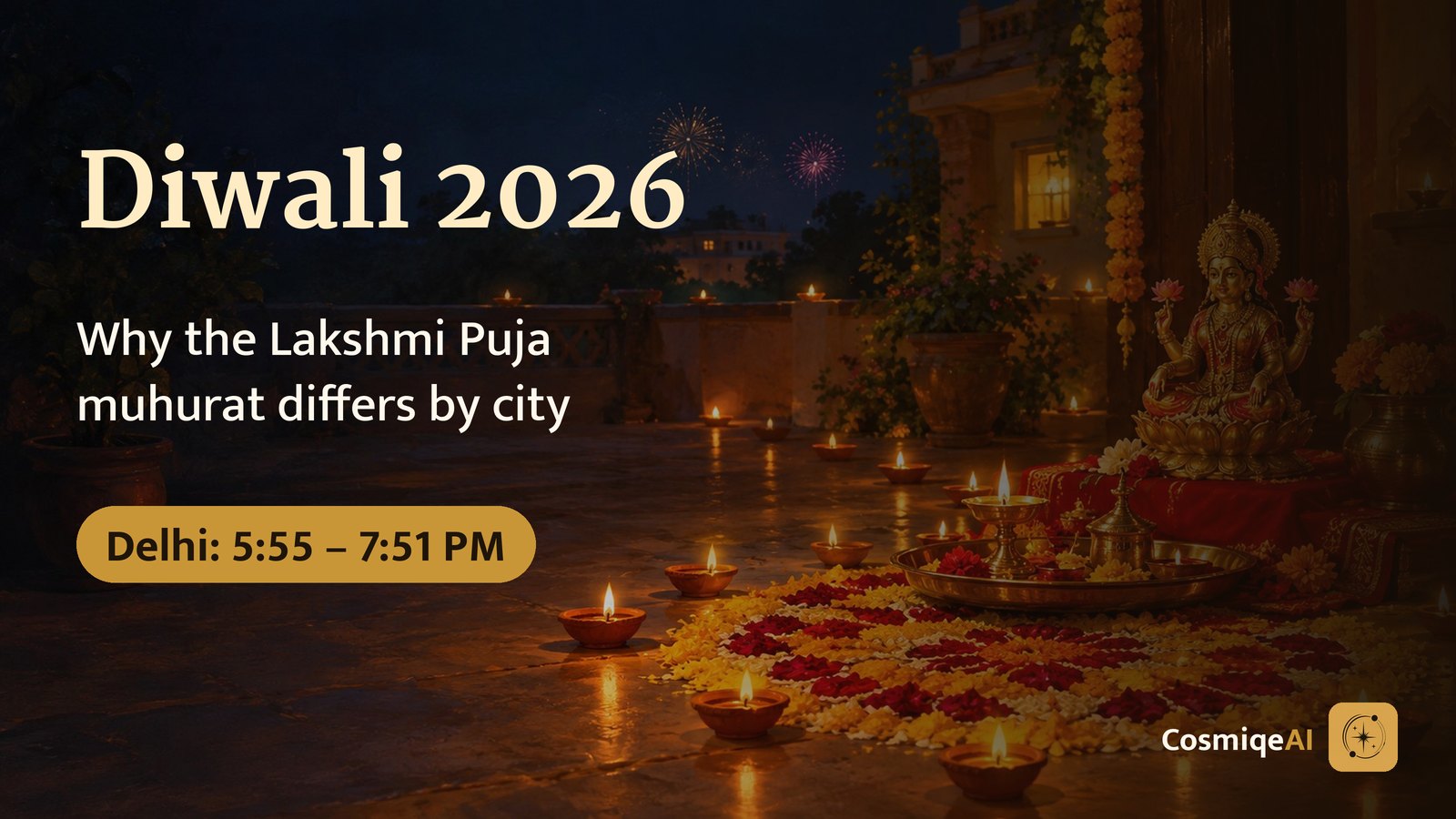
Diwali is on Sunday 8 November 2026. In New Delhi the Lakshmi Puja muhurat is 5:55 PM to 7:51 PM IST, when Pradosh Kaal and the fixed Vrishabha lagna overlap while Amavasya holds. Both begin at each city's own moment, which is why the Diwali muhurat differs by city, by up to 90 minutes. Find yours on our Diwali 2026 page.
Is Diwali on 8 or 9 November 2026?
Diwali 2026 is on Sunday 8 November. The Kartik Amavasya runs from 11:28 AM on 8 November to 12:32 PM on 9 November, so it touches two dates. The Lakshmi Puja goes to the evening on which Amavasya is running in Pradosh Kaal, and only the 8th has that.
The Dharmasindhu, the dharmashastra digest panchang makers use to date festivals, sets this puja in the Pradosh of the Kartik Amavasya. On the evening of the 8th the Amavasya holds from sunset to midnight and beyond. On the 9th it ends at 12:32 PM, hours before sunset, so that evening is already Pratipada.
If your calendar marks Kartik Amavasya on 9 November, it is using the sunrise rule, which decides the Amavasya bath and daan. The morning of the 9th is still Amavasya at sunrise. The Lakshmi Puja follows the evening rule and stays on the 8th.
The rule that decides the Lakshmi Puja time
The Lakshmi Puja muhurat is the time when three things hold at once in your own city: Amavasya is running, it is Pradosh Kaal, and the Vrishabha lagna is rising in the east. In New Delhi on 8 November that is 5:55 PM to 7:51 PM.
- Amavasya is running. The tithi (lunar day) started at 11:28 AM on 8 November, so the whole evening qualifies.
- Pradosh Kaal. Pradosh is the first fifth of the night, counted from sunset to the next sunrise. In New Delhi it runs from 5:32 PM to 8:09 PM, 157 minutes.
- Vrishabha lagna is rising. The lagna is the rashi coming up over the eastern horizon, and it changes about every two hours. Vrishabha (Taurus) is a sthir (fixed) rashi, and families prefer it because a puja done in a fixed lagna is said to keep Lakshmi steady in the home. In New Delhi it rises from 5:55 PM to 7:51 PM.
In New Delhi the Vrishabha lagna sits wholly inside Pradosh, so the muhurat is the lagna's own span: 5:55 PM to 7:51 PM, 116 minutes.
The 23 minutes between sunset and the lagna, and the 18 minutes after it until 8:09 PM, are still Pradosh on Amavasya. A puja in those minutes meets the Dharmasindhu's rule; it misses only the fixed lagna that families add on top.

Why the muhurat moves from city to city
The Lakshmi Puja muhurat moves because both of its clocks are local. Pradosh begins at your city's own sunset, and Vrishabha rises over your city's own horizon. India keeps one time zone, so a city in the east reaches both moments on the clock well before a city in the west. Across the 40 cities on our Diwali page the muhurat opens first in Guwahati at 5:01 PM and last in Rajkot at 6:31 PM, 90 minutes apart.
East and west. The sun sets about four minutes later on the clock for every degree of longitude you go west. Guwahati and Rajkot are 20.9 degrees apart, which accounts for about 84 of those 90 minutes. The rest comes from latitude: in November the sun sets earlier the further north you are, and Guwahati is north of Rajkot.
North and south. The same latitude effect moves cities on one line of longitude. Hyderabad sits almost due south of Delhi, and its muhurat opens 13 minutes later.
The south closes with Pradosh. Nearer the equator the November night is shorter, so Pradosh is shorter too, and Vrishabha takes longer to rise. In 7 southern cities (Chennai, Bengaluru, Mysore, Coimbatore, Madurai, Kochi and Thiruvananthapuram) the lagna is still rising when Pradosh ends, and the muhurat closes with Pradosh. Chennai's runs from 6:07 PM to 8:09 PM.
| City | Sunset (Pradosh begins) | Lakshmi Puja muhurat | Opens against Delhi |
|---|---|---|---|
| Guwahati | 4:37 PM | 5:01 PM – 6:58 PM | 54 min earlier |
| Kolkata | 4:56 PM | 5:21 PM – 7:19 PM | 34 min earlier |
| Patna | 5:04 PM | 5:29 PM – 7:26 PM | 26 min earlier |
| Lucknow | 5:19 PM | 5:43 PM – 7:40 PM | 12 min earlier |
| New Delhi | 5:32 PM | 5:55 PM – 7:51 PM | — |
| Jaipur | 5:40 PM | 6:04 PM – 8:00 PM | 9 min later |
| Chennai | 5:40 PM | 6:07 PM – 8:09 PM | 12 min later |
| Hyderabad | 5:42 PM | 6:08 PM – 8:09 PM | 13 min later |
| Bengaluru | 5:51 PM | 6:18 PM – 8:20 PM | 23 min later |
| Ahmedabad | 5:58 PM | 6:23 PM – 8:21 PM | 28 min later |
| Mumbai | 6:02 PM | 6:28 PM – 8:28 PM | 33 min later |
| Rajkot | 6:06 PM | 6:31 PM – 8:30 PM | 36 min later |
Every one of the 40 cities, each with its own page, is on the Diwali 2026 page. The window is close to two hours everywhere, from 114 minutes in Chandigarh to 122 in Bengaluru; what changes is where those two hours sit on the clock.
What happens if you follow Delhi's time in another city
A Delhi muhurat is right for about one city in three. Only 14 of the other 39 cities open within 10 minutes of Delhi's 5:55 PM, and 19 are 20 minutes or more away. Muhurat lists on television and in forwarded messages are usually Delhi's, and most of them don't say so.
- In the west, Delhi's time starts before sunset. In 11 of the 40 cities the sun has not yet set at 5:55 PM: Mumbai, Pune, Nashik, Surat, Vadodara, Ahmedabad, Rajkot, Kochi, Thiruvananthapuram, Coimbatore and Mysore. A puja started then begins in daylight, outside Pradosh.
- In most of the country, it starts before the lagna. In 24 of the 40 cities Vrishabha has not risen by 5:55 PM. In Rajkot it rises 36 minutes later.
- In the east, it runs past the lagna. Guwahati's Vrishabha window ends at 6:58 PM. Of Delhi's 116 minutes, only 63 fall inside Guwahati's own window. Kolkata's window closes at 7:19 PM.
Before the evening, open your own city's page from the Diwali 2026 page. It gives the sunset, the lagna and the muhurat for that city alone.
Which window to use: home, shop or late night
For a home, the Lakshmi Puja in your city's Pradosh and Vrishabha window is the one that matters. The other windows in muhurat lists serve shops, offices and family traditions of a night puja. All the times below are New Delhi's.
| Who it is for | Window in New Delhi | What it is |
|---|---|---|
| Lakshmi Puja at home | 5:55 PM – 7:51 PM | Pradosh and the fixed Vrishabha lagna together |
| If you miss the lagna | until 8:09 PM | The rest of Pradosh, still on Amavasya |
| Shop or office, by day | 11:28 AM – 12:05 PM (Amrit), 1:26 PM – 2:48 PM (Shubh) | Shubh choghadiya after Amavasya begins |
| Shop or office, in the evening | 5:32 PM – 7:10 PM (Shubh), 7:10 PM – 8:48 PM (Amrit) | Shubh choghadiya after sunset |
| Night puja | 11:39 PM – 12:31 AM | Nishita, the night's middle muhurta |
| After midnight | 12:25 AM – 2:43 AM | Simha, the night's fixed lagna |
Choghadiya splits the day and the night into eight parts each, and trading families often choose a good one (Amrit, Shubh, Labh) for the Chopda Puja, the worship of the new account books. On Diwali it counts only after the Amavasya begins at 11:28 AM, which is why the day's earlier Labh choghadiya is left out. Choghadiya times change by city as well; your city's are on the choghadiya page.
Nishita is the eighth of the night's fifteen muhurtas, around midnight. Families whose tradition keeps a night puja use it, and the Kali Puja of Bengal is kept on this same Amavasya night.
The five days of Diwali 2026
The five days of Diwali 2026 run from Dhanteras on Friday 6 November to Bhai Dooj on Wednesday 11 November. Each day is set by its own tithi and its own rule, so they don't fall on five dates in a row.
| Day | Date | What decides it | Time in New Delhi |
|---|---|---|---|
| Dhanteras | Friday 6 November | Trayodashi in Pradosh (10:31 AM on 6 Nov to 10:48 AM on 7 Nov) | Puja 6:03 PM – 7:58 PM |
| Narak Chaturdashi (Choti Diwali) | Sunday 8 November | Chaturdashi at sunrise (10:48 AM on 7 Nov to 11:28 AM on 8 Nov) | Oil bath before sunrise, 6:37 AM |
| Lakshmi Puja (Diwali) | Sunday 8 November | Amavasya in Pradosh | 5:55 PM – 7:51 PM |
| Govardhan Puja | Tuesday 10 November | Pratipada at sunrise (12:32 PM on 9 Nov to 2:00 PM on 10 Nov) | Morning puja 6:39 AM – 8:50 AM |
| Bhai Dooj | Wednesday 11 November | Dwitiya (2:00 PM on 10 Nov to 3:53 PM on 11 Nov) | Tilak 1:10 PM – 3:20 PM |
What is different about Diwali in 2026
Choti Diwali and the Lakshmi Puja fall on the same date in 2026, Sunday 8 November. Narak Chaturdashi is a sunrise festival, so its oil bath is taken before dawn on the day Chaturdashi holds at sunrise. On 7 November the sun rises in Trayodashi, which runs until 10:48 AM. On 8 November it rises in Chaturdashi, which ends at 11:28 AM, and the Amavasya that the evening puja needs begins the same minute.
Saturday 7 November has no festival of its own, and Monday 9 November sits between the Lakshmi Puja and Govardhan Puja, with the Amavasya ending at 12:32 PM. If you plan travel to family for the festival, plan for the 8th, not the 7th.