Dhanteras 2026
6 November 2026
The first day of Diwali, kept in the evening.
- Trayodashi begins
- 6 Nov, 10:31 AM
- Trayodashi ends
- 7 Nov, 10:48 AM
- Dhanteras puja muhurat
- 6:03 PM – 7:58 PM
- Pradosh Kaal
- 5:33 PM – 8:10 PM
- Vrishabha Kaal (Taurus rising, a fixed lagna)
- 6:03 PM – 7:58 PM
- Kept
- after sunset (pradosh)
- Trayodashi begins
- 27 Oct, 1:04 AM
- Trayodashi ends
- 27 Oct, 10:50 PM
- Dhanteras puja muhurat
- 6:43 PM – 8:15 PM
- Pradosh Kaal
- 5:41 PM – 8:15 PM
- Vrishabha Kaal (Taurus rising, a fixed lagna)
- 6:43 PM – 8:39 PM
- Kept
- after sunset (pradosh)
Dhanteras in 2026, 2027, 2028
with the tithi’s timesDhanteras is Kartik Krishna Trayodashi, the Trayodashi of the krishna paksha of Kartik, so its date is the day on which this tithi is running in pradosh kaal, the evening after sunset. A tithi begins and ends at a real minute, not at midnight, which is why the moment decides the day, and why the same festival can fall on a different date in another country.
For New Delhi, in IST.

Dhanteras puja muhurat in your city
Dhanteras 2026, forty citiesWhy Dhanteras is kept
its meaningDhanteras falls on Kartik Krishna Trayodashi, the thirteenth day of the waning Moon, two days before Diwali, and it opens the five days of the festival. Tradition links the day to Dhanvantari, the physician of the devas, who rose from the samudra manthan (the churning of the ocean) holding the pot of amrit, as the Bhagavata Purana tells. So the day is also kept as Dhanvantari Jayanti, and many families pray for good health before they pray for wealth.
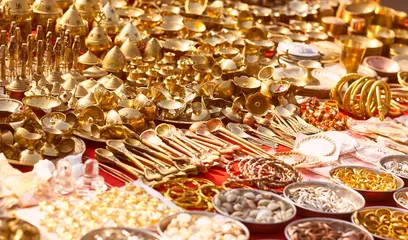
The evening holds three customs. Families buy something new for the home, a steel or brass utensil or a coin of gold or silver, which tradition holds auspicious on this day. Kubera, keeper of the devas’ treasury, and Lakshmi are worshipped in pradosh kaal, the time just after sunset. And a diya is lit for Yama outside the main door, its flame facing south: the Yama deepdaan, kept with the prayer that the family be spared an untimely death.
Puja vidhi
step by step- 1Clean the home and the door
Clean the house, especially the main door, and draw a rangoli at the entrance. Tradition holds that Lakshmi enters a clean, well-lit home.
- 2Bring home something new
Before the puja, buy a utensil, a coin of gold or silver, or whole dhaniya (coriander seed), as your family’s custom is, and keep it for the puja.
- 3Set up the chowki
After sunset, in pradosh kaal, place Lakshmi and Ganesh on a clean chowki (a low wooden seat), with a picture of Kubera and of Dhanvantari beside them, and a kalash of water.
- 4Offer roli, akshat and flowers
Apply roli and akshat (unbroken rice), offer flowers, light a ghee diya and incense, and place the new utensil or coin before them. Pray to Dhanvantari for health and to Kubera and Lakshmi for a steady home.
- 5Light the diya for Yama
Light an earthen diya with mustard oil and place it outside the main door with its flame towards the south, the direction of Yama. Bow and pray that the family be kept from untimely death.
- 6Aarti and prasad
Do the Lakshmi aarti, share the prasad with the family, and light diyas at the door and in the courtyard.
Puja samagri
keep it ready the day before- A chowki with a red or yellow cloth
- Idol or picture of Lakshmi and Ganesh
- Pictures of Kubera and Dhanvantari
- Kalash of water
- Roli, akshat (unbroken rice) and haldi
- Flowers and a garland
- Ghee diya, incense and camphor
- Earthen diya and mustard oil for the Yama deepdaan
- The new utensil or coin
- Whole dhaniya (coriander seed)
- Sweets and batashe for prasad
The katha of Dhanteras
Source: Dhanvantari: Bhagavata Purana, Book 8. King Hima’s son: popular tradition, told with the Yama deepdaan
When the devas and the asuras churned the ocean, many treasures rose from it. Then rose Dhanvantari, a form of Vishnu and the knower of Ayurveda, carrying a pot full of amrit, the nectar of immortality. The Bhagavata Purana tells this, and tradition holds that he appeared on this Trayodashi.
A popular story is told with the Yama lamp. It was foretold that King Hima’s son would die of a snakebite on the fourth night after his marriage. That night his young wife would not let him sleep. She heaped her gold and silver ornaments at the door of the room, lit lamps all around, and kept him awake with stories and songs.
When Yama came in the form of a serpent, the light of the lamps and the shine of the ornaments dazzled him. He could not go in, sat on the heap of jewellery listening to the songs through the night, and left quietly at dawn. Families remember this when they light a lamp for Yama on this evening and pray for long life for their own.
What to do, and what to avoid
What to do
- Buy the new utensil or coin before the puja, so it can be placed before Lakshmi and Kubera and then used in the home.
- Keep the puja in pradosh kaal, the time just after sunset, which tradition holds right for both the Lakshmi puja and the Yama lamp.
- Place the Yama diya outside the main door with its flame towards the south, since south is Yama’s direction.
- Pray for health first. The day is Dhanvantari’s as much as Lakshmi’s, and the old saying holds that the first happiness is a healthy body.
What to avoid
- Many families avoid buying iron, sharp or black things on Dhanteras, keeping the day for bright metals and things for the home.
- Many families avoid lending money or giving things away on this evening, since the day is kept to welcome Lakshmi into the home.
- Avoid leaving the doorway dark at dusk; the lit entrance is part of the day’s worship.
Regional names, and why dates differ
In the Purnimanta calendar of the north, where a month ends on Purnima, Dhanteras is Kartik Krishna Trayodashi. In the Amanta calendar of Gujarat, Maharashtra and the south, where a month ends on Amavasya, the same day is Ashwin Krishna Trayodashi, and Diwali closes the month of Ashwin there. The day is also called Dhantrayodashi, and is kept as Dhanvantari Jayanti.
The date is decided by the Trayodashi in pradosh, the time after sunset, read at each place’s own sunset. When the tithi changes close to sunset, cities with different sunset times can keep Dhanteras on different days.
Common questions
6 questionsWhen is Dhanteras in 2026?
Dhanteras 2026 is on Friday, 6 November 2026, in New Delhi. Pick your city at the top for your own date and times.
What is the Dhanteras puja muhurat in 2026?
In New Delhi, 6:03 PM to 7:58 PM: where Pradosh Kaal (5:33 PM to 8:10 PM) meets Vrishabha Kaal, the fixed lagna, while Trayodashi holds, the same rule as Diwali’s Lakshmi Puja.
What time does Trayodashi begin and end for Dhanteras 2026?
In IST, Trayodashi begins on 6 Nov, 10:31 AM and ends on 7 Nov, 10:48 AM. Dhanteras is kept after sunset (pradosh), which is why it falls on 6 November.
When is Dhanteras in 2027?
Wednesday, 27 October 2027, in New Delhi.
When is Dhanteras in 2028?
Sunday, 15 October 2028, in New Delhi.
Why is Dhanteras on a different day in the US or UK?
Dhanteras is kept on the day its tithi, Trayodashi, is running in pradosh kaal, the evening after sunset. The tithi begins and ends at the same instant all over the world, but sunset comes at its own hour in every place, so in the US or UK the day that holds it can be a day earlier than in India. Pick your city in the box at the top and every date and time on this page is worked out for it.
A festival is the same day for everybody. Your chart is not.
Make your free kundli, or ask any of 24 astrologers what this year holds for you. You pay by the minute.






Chat with an AI astrologer
24 AI astrologers trained in Vedic Jyotish. Chat in any Indian language; call in Hindi and English.Astro VyasaVedic JyotishAstro PremLove & RelationshipAstro KuberWealth & FinanceAstro VaidyaHealth & VitalityChat from Call from Billed per minute, only while your chat or call is on. End it any time.