Diwali 2026
8 November 2026
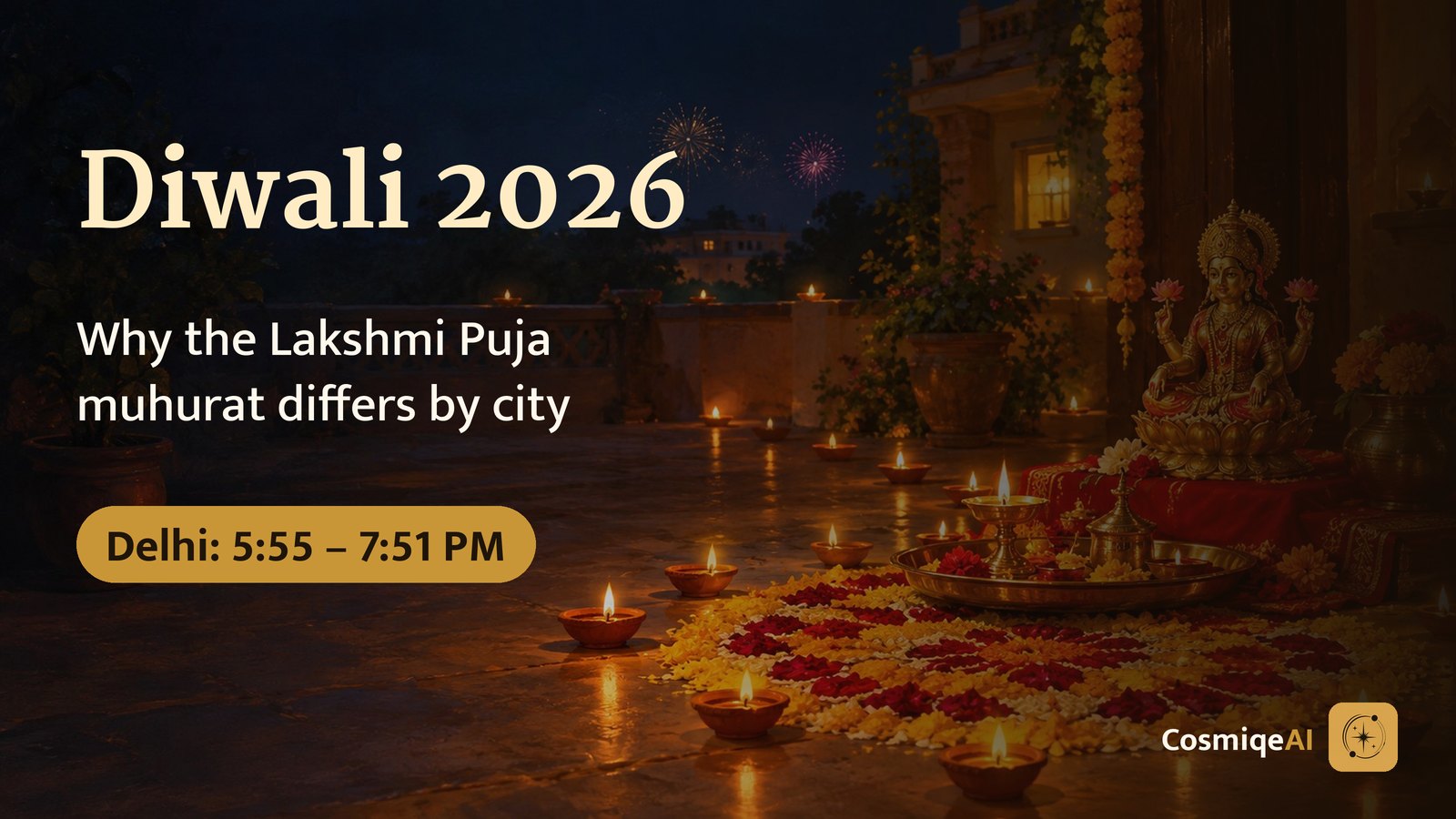
Lakshmi Puja, done in the evening pradosh kaal on the day Amavasya is running after sunset.
- Amavasya begins
- 8 Nov, 11:28 AM
- Amavasya ends
- 9 Nov, 12:32 PM
- Lakshmi Puja muhurat
- 5:55 PM – 7:51 PM
- Pradosh Kaal
- 5:32 PM – 8:09 PM
- Vrishabha Kaal (Taurus rising, a fixed lagna)
- 5:55 PM – 7:51 PM
- Kept
- after sunset (pradosh)
- Amavasya begins
- 28 Oct, 8:48 PM
- Amavasya ends
- 29 Oct, 7:06 PM
- Lakshmi Puja muhurat
- 6:35 PM – 7:06 PM
- Pradosh Kaal
- 5:39 PM – 8:13 PM
- Vrishabha Kaal (Taurus rising, a fixed lagna)
- 6:35 PM – 8:31 PM
- Kept
- after sunset (pradosh)
Diwali in 2026, 2027, 2028
with the tithi’s timesDiwali is Kartik Krishna Amavasya, the Amavasya of the krishna paksha of Kartik, so its date is the day on which this tithi is running in pradosh kaal, the evening after sunset. A tithi begins and ends at a real minute, not at midnight, which is why the moment decides the day, and why the same festival can fall on a different date in another country.
For New Delhi, in IST.
Lakshmi Puja muhurat in your city
Diwali 2026, forty citiesWhy Diwali is kept
its meaningDiwali, or Deepavali, the row of lamps, falls on Kartik Amavasya, the darkest night of the month. Its heart is the Lakshmi Puja, done with Ganesh in pradosh kaal, the time after sunset, and best within the sthir (fixed) lagna of Vrishabha, which rises in the evening at this time of year. Tradition holds that a puja done in a fixed lagna keeps Lakshmi steady in the home.
The night carries more than one meaning. In the north it remembers Rama’s return to Ayodhya with Sita and Lakshman after fourteen years, when, as popular tradition tells, the city lit rows of lamps to welcome him. Tradition also links it with Lakshmi, who rose from the samudra manthan and chose Vishnu. Homes are cleaned, lamps line every edge, and many trading families begin the year’s account books with her blessing.
Puja vidhi
step by step- 1Ready the home
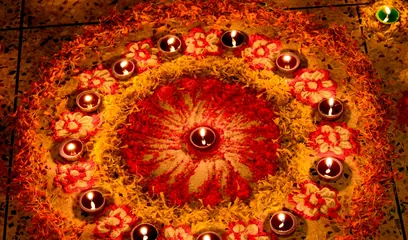
Finish cleaning in the days before, draw a rangoli at the door and hang a bandanwar (toran) of mango or ashoka leaves. Keep the main door lit from dusk.
- 2Set up the new idols
In pradosh kaal, on a chowki covered with red cloth, place the new idols of Ganesh and Lakshmi bought for this year, with a kalash of water topped with mango leaves and a coconut.
- 3Worship Ganesh, then Lakshmi
Begin with Ganesh, then Lakshmi: apply roli, offer akshat (unbroken rice), flowers, a lotus if you have one, and coins. Draw a swastik in roli on the account books or the cash box and worship them too.
- 4Offer khil-batashe
Offer khil (puffed rice), batashe, sweets, fruits and the sugar toys many homes buy for this night.
- 5Light the diyas
Light the main ghee diya before the deities, then carry diyas to every room, the kitchen, the place where water is kept, the door and the roof.
- 6Aarti and prasad
Sing the Lakshmi aarti with the family and share the prasad. Many families keep one diya burning before Lakshmi through the night.
- 7Greet the elders
Touch the feet of elders and exchange sweets with family and neighbours.
Puja samagri
keep it ready the day before- A chowki and red cloth
- New idols or picture of Ganesh and Lakshmi
- Kalash of water with mango leaves and a coconut
- Roli, akshat, haldi and kalava (sacred thread)
- Flowers, a garland, and a lotus if available
- Khil (puffed rice) and batashe
- Sweets, fruits and sugar toys
- Coins and the account books
- A ghee diya, earthen diyas, oil and wicks
- Incense and camphor
- Rangoli colours and a bandanwar
The katha of Diwali
Source: Popular tradition of North India; Rama’s return itself is told in the Valmiki Ramayana, Yuddha Kanda
After fourteen years in the forest and the war in Lanka, Rama, with Sita and Lakshman, set out for home in the Pushpaka vimana. All those years Bharata had ruled in his brother’s name, keeping Rama’s sandals on the throne and living as an ascetic at Nandigram.
Stopping at the ashram of the sage Bharadvaja, Rama sent Hanuman ahead to tell Bharata that he was coming. Bharata was overjoyed. The roads were prepared, the city was decorated, and Bharata, with Shatrughna, the queen mothers and the people of Ayodhya, went out to meet their king. When the brothers met, Bharata placed Rama’s sandals back on his feet and returned the kingdom he had kept for him. Rama was crowned soon after.
Popular tradition holds that on that night, the dark Amavasya of Kartik, the people lit rows of lamps across Ayodhya to welcome Rama home, and that every diya lit on Diwali carries on that welcome.
What to do, and what to avoid
What to do
- Do the Lakshmi Puja in pradosh kaal, and within the Vrishabha lagna if you can, since tradition prefers a fixed lagna for this puja.
- Bring new Ganesh-Lakshmi idols each year, as the custom is, and set last year’s aside respectfully, in clean water or at a temple, as your family does.
- Light a diya in every corner, including the kitchen and the place where water is kept, since tradition holds that Lakshmi comes to a clean, lit home.
- Keep the main door open and lit during the puja, so the home stands ready to welcome Lakshmi.
What to avoid
- Many families avoid sweeping the house or throwing out rubbish after the Lakshmi Puja that night, so as not to sweep Lakshmi out.
- Avoid quarrels and harsh words that evening; tradition holds that Lakshmi stays where there is peace.
- Keep fireworks well away from the diyas, from children on their own, from elders and from animals; a festival of lamps is spoilt by a burn.
Regional names, and why dates differ
In the Purnimanta calendar of the north Diwali is Kartik Amavasya; in the Amanta calendar of Gujarat, Maharashtra and the south, where the month ends on Amavasya, the same night is Ashwin Amavasya, the last night of Ashwin. In Bengal, Odisha and Assam the night is Kali Puja, with Kali worshipped at midnight. In Gujarat traders do Chopda Puja, the worship of new account books, and the Gujarati new year begins the next morning. In Tamil Nadu, Deepavali is kept on the morning of the Chaturdashi, the day before.
Lakshmi Puja needs the Amavasya in pradosh, read at each place’s own sunset. When the Amavasya spans parts of two evenings, the panchang chooses by which evening it covers in pradosh, so cities with different sunset times can differ by a day. Kali Puja looks for the Amavasya at midnight instead, so in some years it falls on a different date from Lakshmi Puja.
Common questions
6 questionsWhen is Diwali in 2026?
Diwali 2026 is on Sunday, 8 November 2026, in New Delhi. Pick your city at the top for your own date and times.
What is the Lakshmi Puja muhurat on Diwali 2026?
In New Delhi, 5:55 PM to 7:51 PM. That is where Pradosh Kaal (5:32 PM to 8:09 PM) meets Vrishabha Kaal, the fixed lagna, while Amavasya holds: a Lakshmi Puja done in a fixed lagna is said to keep Lakshmi in the home.
What time does Amavasya begin and end for Diwali 2026?
In IST, Amavasya begins on 8 Nov, 11:28 AM and ends on 9 Nov, 12:32 PM. Diwali is kept after sunset (pradosh), which is why it falls on 8 November.
When is Diwali in 2027?
Friday, 29 October 2027, in New Delhi.
When is Diwali in 2028?
Tuesday, 17 October 2028, in New Delhi.
Why is Diwali on a different day in the US or UK?
Diwali is kept on the day its tithi, Amavasya, is running in pradosh kaal, the evening after sunset. The tithi begins and ends at the same instant all over the world, but sunset comes at its own hour in every place, so in the US or UK the day that holds it can be a day earlier than in India. Pick your city in the box at the top and every date and time on this page is worked out for it.
A festival is the same day for everybody. Your chart is not.
Make your free kundli, or ask any of 24 astrologers what this year holds for you. You pay by the minute.





Chat with an AI astrologer
24 AI astrologers trained in Vedic Jyotish. Chat in any Indian language; call in Hindi and English.Astro VyasaVedic JyotishAstro PremLove & RelationshipAstro KuberWealth & FinanceAstro VaidyaHealth & VitalityChat from Call from Billed per minute, only while your chat or call is on. End it any time.