Consult
Free tools
More
Jivitputrika (Jitiya) 2027
23 September 2027
Mothers keep a nirjala fast through the day and night for their children’s long life.
- Ashtami begins
- 23 Sep, 4:37 AM
- Ashtami ends
- 24 Sep, 2:57 AM
- Kept
- at sunrise
- Ashtami begins
- 11 Sep, 6:10 PM
- Ashtami ends
- 12 Sep, 6:10 PM
- Kept
- at sunrise
Jivitputrika (Jitiya) in 2026, 2027, 2028
with the tithi’s timesJivitputrika (Jitiya) is Ashwin Krishna Ashtami, the Ashtami of the krishna paksha of Ashwin, so its date is the day on which this tithi is running at sunrise. A tithi begins and ends at a real minute, not at midnight, which is why the moment decides the day, and why the same festival can fall on a different date in another country.
For New Delhi, in IST.

Why Jivitputrika (Jitiya) is kept
its meaningJivitputrika, also called Jitiya, is kept mainly by mothers in Bihar, Jharkhand and eastern Uttar Pradesh, with a nirjala fast through a full day and night, for their children’s long life and wellbeing. Many keep three stages: Nahay-Khay the day before, with a meal eaten before the fast begins; the nirjala vrat itself through the next day and night; and parana, breaking the fast, the following morning.
The vrat’s name comes from Jimutavahana, whose story is read as the Jivitputrika vrat katha: a prince who gave his own life to save another’s child, and whose devotion is why mothers keep this fast for their own children. Through the night of the vrat, many households also hear a second, simpler tale, of a jackal and a kite, told as a warning against breaking faith halfway.
Puja vidhi
step by step- 1Nahay-Khay
The day before, bathe and eat a full meal, since the fast ahead is kept without food or water.
- 2Sankalp
Take the sankalp for the vrat, resolving to keep it nirjala for your children’s long life.
- 3The vrat
Keep the fast through the day and the following night without food or water, as your health allows.
- 4Puja
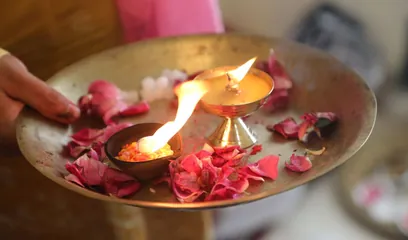
In the evening, worship Jimutavahana, or an image of the family deity, with roli, akshat, flowers and a diya.
- 5Hear the katha
Hear or read the story of Jimutavahana, and the tale of the jackal and the kite, through the night’s vigil.
- 6Parana
Break the fast the next morning, taking water first and then food, once the night has passed.
Puja samagri
keep it ready the day before- Roli, akshat and kalava
- Flowers and a garland
- Diya and ghee
- The Nahay-Khay meal, the day before
- Food kept ready for parana
The katha of Jivitputrika (Jitiya)
Source: Kathasaritsagara, read as the Jivitputrika vrat katha
Jimutavahana, a Vidyadhara prince, once came upon a Naga mother weeping on a rock by the sea, waiting for Garuda to come and carry off her last son, as Garuda had carried off one Naga child every day under an old agreement between the two peoples.
Moved by her grief, Jimutavahana offered himself in the son’s place, wrapping himself in red cloth as the Nagas did before being taken, and waited on the rock for Garuda to come.
When Garuda arrived and lifted him away, he realised, from Jimutavahana’s calm in the face of death, that this was no ordinary Naga child but a man who had given himself for another’s son. Garuda, moved in turn, spared him, and from that day gave up the old agreement, sparing every Naga child after. Mothers keep the Jivitputrika vrat, the story says, in the hope of such devotion and protection for their own children.
What to do, and what to avoid
What to do
- Keep the Nahay-Khay meal substantial the evening before, since the fast that follows is kept without food or water for a full day and night.
- If you are unwell, pregnant or nursing, elders commonly allow water during the fast; the vrat is kept for your children, and if you have a health condition, check with a doctor before fasting without water.
- Keep the parana meal simple the next morning, breaking the fast gently after a night without food or water.
What to avoid
- The fast is not broken before its full term of a day and a night, except where health requires it.
- Harsh words or quarrels are usually set aside through the vrat, since it is kept in a spirit of devotion for the children of the house.
Regional names, and why dates differ
Jivitputrika is kept most widely in Bihar, Jharkhand and eastern Uttar Pradesh, where it is called Jitiya in everyday speech, and the exact day of Nahay-Khay or parana is sometimes counted a little differently from one family to another.
Coming festivals
the next sixCommon questions
5 questionsWhen is Jivitputrika (Jitiya) in 2027?
Jivitputrika (Jitiya) 2027 is on Thursday, 23 September 2027, in New Delhi. Pick your city at the top for your own date and times.
What time does Ashtami begin and end for Jivitputrika (Jitiya) 2027?
In IST, Ashtami begins on 23 Sep, 4:37 AM and ends on 24 Sep, 2:57 AM. Jivitputrika (Jitiya) is kept at sunrise, which is why it falls on 23 September.
When is Jivitputrika (Jitiya) in 2026?
Saturday, 3 October 2026, in New Delhi.
When is Jivitputrika (Jitiya) in 2028?
Tuesday, 12 September 2028, in New Delhi.
Why is Jivitputrika (Jitiya) on a different day in the US or UK?
Jivitputrika (Jitiya) is kept on the day its tithi, Ashtami, is running at sunrise. The tithi begins and ends at the same instant all over the world, but sunrise comes at its own hour in every place, so in the US or UK the day that holds it can be a day earlier than in India. Pick your city in the box at the top and every date and time on this page is worked out for it.
A festival is the same day for everybody. Your chart is not.
Make your free kundli, or ask any of 24 astrologers what this year holds for you. You pay by the minute.






Chat with an AI astrologer
24 AI astrologers trained in Vedic Jyotish. Chat in any Indian language; call in Hindi and English.Astro VyasaVedic astrology & kundli analysisAstro PremMarriage astrology & kundli matchingAstro KuberWealth & financial astrologyAstro VaidyaHealth & wellness astrologyChat from Call from Billed per minute, only while your chat or call is on. End it any time.