Sharad Navratri 2027
30 September 2027
Nine nights of the Goddess, from Ashwin Shukla Pratipada, with Ghatasthapana on the first morning.
- Pratipada begins
- 30 Sep, 8:06 AM
- Pratipada ends
- 1 Oct, 5:35 AM
- Ghatasthapana muhurat
- 8:06 AM – 10:12 AM
- or in Abhijit muhurat
- 11:47 AM – 12:35 PM
- Kept
- on the day its tithi begins, as it touches no sunrise in 2027 (kshaya)
- Pratipada begins
- 18 Sep, 11:53 PM
- Pratipada ends
- 19 Sep, 8:00 PM
- Ghatasthapana muhurat
- 6:08 AM – 10:12 AM
- or in Abhijit muhurat
- 11:50 AM – 12:39 PM
- Kept
- at sunrise
Sharad Navratri in 2026, 2027, 2028
with the tithi’s timesSharad Navratri is Ashwin Shukla Pratipada, the Pratipada of the shukla paksha of Ashwin, so its date is the day on which this tithi is running at sunrise. In 2027 the tithi starts after one sunrise and ends before the next, so it is kept on the day it begins. A tithi that no sunrise touches is called kshaya. A tithi begins and ends at a real minute, not at midnight, which is why the moment decides the day, and why the same festival can fall on a different date in another country.
For New Delhi, in IST.

Why Sharad Navratri is kept
its meaningSharad (Shardiya) Navratri runs for nine nights, from Ashwin Shukla Pratipada to Navami, and each day is given to one of the nine forms of Durga: Shailputri, Brahmacharini, Chandraghanta, Kushmanda, Skandamata, Katyayani, Kalaratri, Mahagauri and Siddhidatri. The day after Navami is Vijayadashami. Of the four Navratris in the year, this autumn one and Chaitra Navratri in spring are kept in most homes; the two in Magha and Ashadha are called Gupt Navratri.
The story behind these nights comes from the Devi Mahatmya, part of the Markandeya Purana, which tells how the Devi defeated the buffalo-demon Mahishasura when the gods could not. Its seven hundred verses, read as the Durga Saptashati, are recited in many homes through the nine days. Families keep the vrat (fast), light the jyoti, sow barley beside the kalash and close with kanya pujan, honouring the Devi in young girls.
Puja vidhi
step by step- 1Ghatasthapana
On the first morning, while Pratipada holds, set up the kalash on a bed of clean soil sown with barley (jau), with mango leaves and a coconut wrapped in red cloth on top. If the morning is not possible, many families use the Abhijit muhurat around midday.
- 2Light the jyoti
Light a ghee diya before the Devi. Families who keep an akhand jyoti (a lamp that burns without a break) tend it through all nine days.
- 3Worship the form of the day
Each morning and evening, worship that day’s form with roli, akshat (unbroken rice), flowers and bhog, and sprinkle a little water on the barley.
- 4Read the path
Read the Durga Saptashati, or a part of it each day. If time is short, the Devi Kavach and the aarti are enough.
- 5Keep the vrat
Keep the vrat the way your family does: some fast all nine days on phalahar (fruit and vrat food), others on the first and last days only.
- 6Kanya pujan
On Ashtami or Navami, by family custom, invite young girls, wash their feet, apply tilak, and feed them halwa, puri and kala chana before giving a small gift.
- 7Closing the nine days
On Dashami the kalash is moved, and the sprouted barley (jawara) is immersed or shared as prasad, as the family’s custom is.
Puja samagri
keep it ready the day before- Kalash of copper or clay, with a coin and supari inside
- Clean soil and barley (jau) for sowing
- Five mango leaves
- Coconut wrapped in red cloth or chunari
- Ganga jal
- Roli, akshat and kalava
- Red chunari for the Devi
- Ghee and a diya, or a lamp for the akhand jyoti
- Flowers, fruits and sweets for bhog
- Durga Saptashati book
The katha of Sharad Navratri
Source: Devi Mahatmya (Markandeya Purana), the slaying of Mahishasura
Mahishasura, a demon who could take the form of a buffalo, defeated the gods in battle and took Indra’s place in heaven. The gods, led by Brahma, went to Vishnu and Shiva and told them what had happened.
As they listened, their anger blazed out as light, and light came from the bodies of the other gods too. It gathered into one radiance and took the form of a goddess. The gods gave her their weapons: Shiva a trident from his own, Vishnu a discus from his, and Himavan, the mountain, gave her a lion to ride.
She went into battle and destroyed Mahishasura’s army and generals. Mahisha himself fought her in many shapes: a buffalo, a lion, a man with a sword, an elephant, and the buffalo again. At last she pressed him down with her foot and struck him with her trident, and as he began to come out of the buffalo’s mouth in his own form, she cut off his head with her sword.
The gods praised her, and she promised to come to their aid whenever they remembered her in trouble. This is why she is called Mahishasuramardini.
What to do, and what to avoid
What to do
- Set up the kalash in the north-east corner if you can, the direction tradition gives to the gods.
- Sprinkle a little water on the barley each day; its growth is traditionally taken as a good sign for the year ahead.
- Keep the vrat at a level your health allows; phalahar with fruit, milk, kuttu or singhara flour and sendha namak is the usual way, and tradition values the bhav over hardship.
- If you light an akhand jyoti, make sure someone is at home to tend it, so it is never left burning unattended.
What to avoid
- Onion, garlic, meat and alcohol are kept out of the kitchen in most homes for the nine days, so that the food offered and eaten stays sattvik.
- Those keeping the vrat avoid grains and ordinary salt, and use sendha namak (rock salt) instead.
- Many families avoid cutting hair or nails and shaving during the nine days; follow your own family’s custom here.
Regional names, and why dates differ
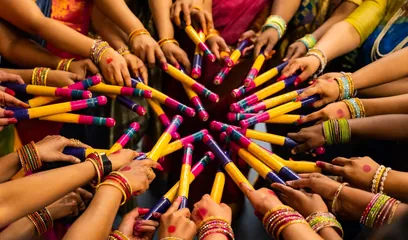
In the north, Ramlila is staged through these nights and ends with Ravana dahan on Dussehra. In Gujarat the nights are for Garba, danced in circles around the garbo, an earthen pot with a lamp inside. In Bengal the same days are Durga Puja, whose main days run from Shashthi to Dashami; Bengal calls this autumn worship Akal Bodhan, the untimely awakening of the goddess, after Rama’s worship of her before his battle with Ravana as the Krittivasi Ramayana tells it.
Since this is Shukla paksha, Amanta and Purnimanta calendars both call it Ashwin, so there is no month-name difference. Days can still differ: a tithi can be skipped or can hold over two sunrises, so Navratri is sometimes eight days long or ten, read at each place’s own sunrise. Bengal’s panjikas reckon Ashtami and Navami by their own rules, so Bengal’s Navami can fall a day after the north’s.
Common questions
6 questionsWhen is Sharad Navratri in 2027?
Sharad Navratri 2027 is on Thursday, 30 September 2027, in New Delhi. Pick your city at the top for your own date and times.
What is the Ghatasthapana muhurat in 2027?
In New Delhi, 8:06 AM to 10:12 AM: the first third of the day while Pratipada holds. If that is missed, Abhijit muhurat, 11:47 AM to 12:35 PM.
What time does Pratipada begin and end for Sharad Navratri 2027?
In IST, Pratipada begins on 30 Sep, 8:06 AM and ends on 1 Oct, 5:35 AM. Sharad Navratri is kept on the day its tithi begins, as it touches no sunrise in 2027 (kshaya), which is why it falls on 30 September.
When is Sharad Navratri in 2026?
Sunday, 11 October 2026, in New Delhi.
When is Sharad Navratri in 2028?
Tuesday, 19 September 2028, in New Delhi.
Why is Sharad Navratri on a different day in the US or UK?
Sharad Navratri is kept on the day its tithi, Pratipada, is running at sunrise. The tithi begins and ends at the same instant all over the world, but sunrise comes at its own hour in every place, so in the US or UK the day that holds it can be a day earlier than in India. Pick your city in the box at the top and every date and time on this page is worked out for it.
A festival is the same day for everybody. Your chart is not.
Make your free kundli, or ask any of 24 astrologers what this year holds for you. You pay by the minute.






Chat with an AI astrologer
24 AI astrologers trained in Vedic Jyotish. Chat in any Indian language; call in Hindi and English.Astro VyasaVedic JyotishAstro PremLove & RelationshipAstro KuberWealth & FinanceAstro VaidyaHealth & VitalityChat from Call from Billed per minute, only while your chat or call is on. End it any time.