Karva Chauth 2026
29 October 2026
The fast is broken at moonrise, so the evening decides the day.
- Chaturthi begins
- 29 Oct, 1:07 AM
- Chaturthi ends
- 29 Oct, 10:10 PM
- Moonrise in New Delhi
- 8:17 PM
- Kept
- in the evening, up to moonrise, when the fast is broken
- Chaturthi begins
- 18 Oct, 5:52 PM
- Chaturthi ends
- 19 Oct, 4:42 PM
- Moonrise in New Delhi
- 7:35 PM
- Kept
- in the evening, up to moonrise, when the fast is broken
Karva Chauth in 2026, 2027, 2028
with the tithi’s timesKarva Chauth is Kartik Krishna Chaturthi, the Chaturthi of the krishna paksha of Kartik, so its date is the day on which this tithi is running in the evening, up to moonrise. A tithi begins and ends at a real minute, not at midnight, which is why the moment decides the day, and why the same festival can fall on a different date in another country.
For New Delhi, in IST.

Moonrise in your city
Karva Chauth 2026, forty citiesWhy Karva Chauth is kept
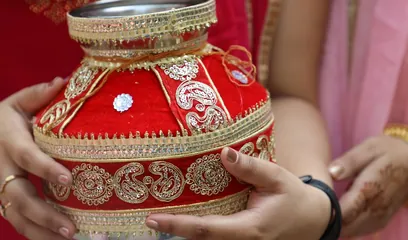
its meaningKarva Chauth is Kartik Krishna Chaturthi in the Purnimanta calendar of the north, the fourth day after the Sharad Purnima. Married women keep a nirjala vrat (without food or water) from before sunrise until the moon rises, for their husband’s long life and the wellbeing of the home, and break it at moonrise after offering arghya to Chandra. The day takes its name from the karva, the earthen pot with a spout used in the puja.
The day begins with sargi, the meal a mother-in-law sends or serves before dawn. In the evening the women gather, dressed as suhagans, for the puja and the katha, passing their thalis around the circle. At moonrise each woman looks at the moon through a chhalni (sieve), then at her husband, offers arghya from the karva, and takes her first sip of water from her husband’s hand.
Puja vidhi
step by step- 1Sargi
Before sunrise, eat the sargi: fruit, dry fruits, pheniyan or mathri, and whatever your family sends, then take the sankalp (resolve) for the vrat.
- 2The day’s vrat
Keep the vrat through the day, without food or water if your health allows.
- 3Prepare the puja
In the evening, set up an image of Karva Mata or draw her on the wall, make a small Gauri of clay, and fill the karva with water.
- 4Puja and katha
Worship Gauri and Karva Mata with roli, akshat, sindoor and sweets, and hear the Karva Chauth katha with the other women, passing the thalis around the circle as you sing.
- 5Baya
Set aside the baya, a gift of sweets, clothes or money, and give it to your mother-in-law with a touch of her feet.
- 6Moonrise
When the moon rises, look at it through the chhalni, then at your husband, and offer arghya to Chandra from the karva.
- 7Breaking the vrat
Take the first sip of water and the first bite from your husband’s hand, then eat with the family.
Puja samagri
keep it ready the day before- Karva (earthen pot) with a spout and a lid
- Chhalni (sieve)
- Image of Karva Mata
- Clay for making Gauri
- Roli, akshat, sindoor and kalava
- Diya and ghee
- Puja thali with sweets and mathri
- Lota of water for arghya
- Sargi: fruit, dry fruits, pheniyan, mathri
- Baya for the mother-in-law
- Red chunari and shringar
The katha of Karva Chauth
Source: Folk tradition of North India, told at the evening puja; versions differ from family to family
Veeravati was the only sister of seven brothers, who loved her dearly. She kept her first Karva Chauth at her parents’ home, and by evening she was faint with hunger and thirst. Her brothers could not bear to see her suffer. They lit a fire behind a tree on a hill (in some tellings they held a lamp behind a sieve) so that it looked like the rising moon, and told her the moon was out.
Veeravati offered arghya to the false moon and broke her fast. At the first bites came bad omens, and then the news that her husband had died. Grieving, she learned that she had broken her vrat before the true moon rose. In the version told most often, she kept watch over her husband through the year and kept every Chauth vrat faithfully, and on the next Karva Chauth, by the grace of the goddess (Indrani in some tellings, Mata Parvati in others), her husband was restored to life.
Another story often told is of Karva, a devoted wife whose husband was seized by a crocodile while bathing in the river. She bound the crocodile with a cotton thread and went to Yama, asking him to take the crocodile and spare her husband. Moved by her devotion, Yama gave her husband a long life.
What to do, and what to avoid
What to do
- Eat sargi before sunrise, so the day-long fast is easier to keep.
- Check the moonrise time for your own city, since the moon rises at different times in different places and the vrat is broken only when you see it.
- If you are unwell, pregnant or nursing, it is common for elders to allow water or phalahar; the vrat is kept in the bhav, and your health comes first.
- If clouds hide the moon, follow your family’s custom, such as offering arghya in the moon’s direction at the time it rises in your city.
What to avoid
- Don’t break the vrat before the moon is truly seen, the very mistake the Veeravati katha warns of.
- Black and white clothes are usually kept aside; red and bright colours are worn as the marks of a suhagan.
- Some families avoid sewing and cutting cloth on this day; follow your own family’s custom.
Regional names, and why dates differ
Karva Chauth is kept mainly in Punjab, Haryana, Delhi, Rajasthan, Uttar Pradesh, Madhya Pradesh and Himachal, and is also called Karak Chaturthi. It falls on the same Chaturthi as the Sankashti Chaturthi of Ganesh, so some homes worship Ganesh with Gauri at the evening puja.
The same day is Ashwin Krishna Chaturthi in the Amanta calendars of Gujarat, Maharashtra and the south, since those months end on Amavasya; only the month name differs. The day is the one on which the Chaturthi holds at moonrise, read at each place’s own moonrise, which is also why the time of breaking the vrat differs from city to city and between India and abroad.
Common questions
6 questionsWhen is Karva Chauth in 2026?
Karva Chauth 2026 is on Thursday, 29 October 2026, in New Delhi. Pick your city at the top for your own date and times.
What time is moonrise on Karva Chauth 2026?
In New Delhi, 8:17 PM. The Moon rises earlier in the east of India and later in the west and south: in 2026 from 7:23 PM in Guwahati to 9:08 PM in Kochi and Thiruvananthapuram. The Karva Chauth page gives the time for each city.
What time does Chaturthi begin and end for Karva Chauth 2026?
In IST, Chaturthi begins on 29 Oct, 1:07 AM and ends on 29 Oct, 10:10 PM. Karva Chauth is kept in the evening, up to moonrise, when the fast is broken, which is why it falls on 29 October.
When is Karva Chauth in 2027?
Monday, 18 October 2027, in New Delhi.
When is Karva Chauth in 2028?
Saturday, 7 October 2028, in New Delhi.
Why is Karva Chauth on a different day in the US or UK?
Karva Chauth is kept on the day its tithi, Chaturthi, is running in the evening, up to moonrise. The tithi begins and ends at the same instant all over the world, but sunset comes at its own hour in every place, so in the US or UK the day that holds it can be a day earlier than in India. Pick your city in the box at the top and every date and time on this page is worked out for it.
A festival is the same day for everybody. Your chart is not.
Make your free kundli, or ask any of 24 astrologers what this year holds for you. You pay by the minute.






Chat with an AI astrologer
24 AI astrologers trained in Vedic Jyotish. Chat in any Indian language; call in Hindi and English.Astro VyasaVedic JyotishAstro PremLove & RelationshipAstro KuberWealth & FinanceAstro VaidyaHealth & VitalityChat from Call from Billed per minute, only while your chat or call is on. End it any time.