Akshaya Tritiya 2027
8 May 2027
The day whose good deeds never run out: gold, daan and new beginnings.
- Tritiya begins
- 8 May, 11:43 AM
- Tritiya ends
- 9 May, 9:03 AM
- Kept
- at midday (madhyahna)
- Tritiya begins
- 27 Apr, 1:47 AM
- Tritiya ends
- 28 Apr, 1:28 AM
- Kept
- at midday (madhyahna)
Akshaya Tritiya in 2026, 2027, 2028
with the tithi’s timesAkshaya Tritiya is Vaishakh Shukla Tritiya, the Tritiya of the shukla paksha of Vaishakh, so its date is the day on which this tithi is running at midday. A tithi begins and ends at a real minute, not at midnight, which is why the moment decides the day, and why the same festival can fall on a different date in another country.
For New Delhi, in IST.

Why Akshaya Tritiya is kept
its meaningAkshaya Tritiya, Vaishakh Shukla Tritiya kept at madhyahna (midday), takes its name from akshaya, that which never diminishes. Tradition holds that merit earned by charity, worship or a good deed on this day does not wane, which is why it is counted among the most auspicious days of the whole year, needing no separate muhurat for a new beginning.
The Mahabharata tells of the Akshaya Patra, the inexhaustible vessel Surya gave Draupadi during the Pandavas’ exile, from which Yudhishthira could feed any number of guests without it ever running empty, and this day is remembered for that gift. It is also kept as Parashurama Jayanti, the birth of Vishnu’s sixth avatar, and by many Jain families as the day Rishabhanatha, the first Tirthankara, broke a year-long fast, when it is called Akha Teej.
Puja vidhi
step by step- 1Bathe and resolve
Bathe early and take a sankalp, a resolve, for the day’s charity or worship.
- 2Worship Vishnu-Lakshmi
Offer roli, akshat, flowers and panchamrit to Vishnu and Lakshmi, or to Parashurama where he is kept as the day’s deity.
- 3Give in charity
Give food, water, grain, clothes or money to those in need, since the day’s merit is held to be akshaya, never diminishing.
- 4A new purchase
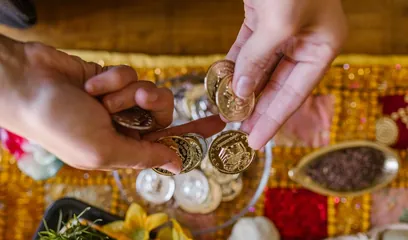
Many buy gold, silver or a new utensil as their family’s custom, placing it before the deity first; this is a custom, not a rule about money.
- 5Tarpan for ancestors
Some families also offer tarpan to ancestors on this day, as certain traditions keep it for the pitrs too.
- 6Satyanarayan puja
Many homes or temples hold a Satyanarayan katha and puja on this day.
- 7Start what you have planned
Sowing a first seed, opening a venture or beginning a new ledger is kept auspicious today, without needing a separate muhurat.
Puja samagri
keep it ready the day before- Idol or picture of Vishnu-Lakshmi or Parashurama
- Roli, akshat and flowers
- Panchamrit
- A new coin or small utensil
- Grain or food for charity
- Water for tarpan, if kept
The katha of Akshaya Tritiya
Source: The Akshaya Patra: Mahabharata, Vana Parva. Parashurama’s birth: Puranic tradition
During the Pandavas’ exile in the forest, Draupadi worried she could not feed the many sages and guests who came to them. Surya, the Sun god, gave her the Akshaya Patra, a vessel from which food would never run out until Draupadi herself had eaten; so long as she served others first, it filled again each time it was emptied.
Puranic tradition also holds this tithi as the birth of Parashurama to the sage Jamadagni and Renuka, Vishnu’s sixth avatar, born to rid the earth of an unjust warrior class of his time; he is remembered for his axe and his fierce devotion to dharma. Jain tradition, separately, holds that Rishabhanatha, the first Tirthankara, broke a year-long fast on this day with sugarcane juice, which is why some Jain families also call it Akha Teej.
What to do, and what to avoid
What to do
- Give something in charity before you buy anything, if you can; even a small daan first keeps the day’s older meaning ahead of its newer, shopping one.
- Start what you have been waiting to start, since tradition holds the day needs no separate muhurat for a new beginning.
What to avoid
- Avoid buying gold or anything else beyond your means; the custom is a token new purchase, not a price to meet.
- Avoid wasting food or grain today of all days, given what the day itself is kept for.
Regional names, and why dates differ
Akshaya Tritiya is kept as Parashurama Jayanti in most of the country, and as Akha Teej by many Jain families, marking Rishabhanatha’s fast-breaking. In Odisha, farmers mark the day as Akshaya Tritiya for sowing the year’s first paddy seed, and it also opens preparations for the Rath Yatra season at Puri.
Common questions
5 questionsWhen is Akshaya Tritiya in 2027?
Akshaya Tritiya 2027 is on Saturday, 8 May 2027, in New Delhi. Pick your city at the top for your own date and times.
What time does Tritiya begin and end for Akshaya Tritiya 2027?
In IST, Tritiya begins on 8 May, 11:43 AM and ends on 9 May, 9:03 AM. Akshaya Tritiya is kept at midday (madhyahna), which is why it falls on 8 May.
When is Akshaya Tritiya in 2026?
Sunday, 19 April 2026, in New Delhi.
When is Akshaya Tritiya in 2028?
Thursday, 27 April 2028, in New Delhi.
Why is Akshaya Tritiya on a different day in the US or UK?
Akshaya Tritiya is kept on the day its tithi, Tritiya, is running at midday. The tithi begins and ends at the same instant all over the world, but midday comes at its own hour in every place, so in the US or UK the day that holds it can be a day earlier than in India. Pick your city in the box at the top and every date and time on this page is worked out for it.
A festival is the same day for everybody. Your chart is not.
Make your free kundli, or ask any of 24 astrologers what this year holds for you. You pay by the minute.






Chat with an AI astrologer
24 AI astrologers trained in Vedic Jyotish. Chat in any Indian language; call in Hindi and English.Astro VyasaVedic JyotishAstro PremLove & RelationshipAstro KuberWealth & FinanceAstro VaidyaHealth & VitalityChat from Call from Billed per minute, only while your chat or call is on. End it any time.