Hanuman Jayanti 2027
20 April 2027
Hanuman’s birth, on the full moon of Chaitra.
- Purnima begins
- 20 Apr, 4:51 AM
- Purnima ends
- 21 Apr, 3:57 AM
- Kept
- at sunrise
- Purnima begins
- 8 Apr, 7:11 PM
- Purnima ends
- 9 Apr, 3:56 PM
- Kept
- at sunrise
Hanuman Jayanti in 2026, 2027, 2028
with the tithi’s timesHanuman Jayanti is Chaitra Shukla Purnima, the Purnima of the shukla paksha of Chaitra, so its date is the day on which this tithi is running at sunrise. A tithi begins and ends at a real minute, not at midnight, which is why the moment decides the day, and why the same festival can fall on a different date in another country.
For New Delhi, in IST.

Why Hanuman Jayanti is kept
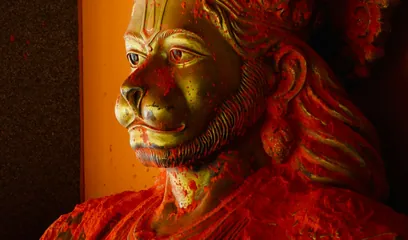
its meaningIn most of North India, Hanuman Jayanti is kept on Chaitra Shukla Purnima, remembering the birth of Hanuman to Anjana and Kesari, blessed by Vayu, the wind god, as the Valmiki Ramayana tells in the Kishkindha Kanda. Devotion to Hanuman, honoured as Bajrang Bali, the embodiment of strength, devotion and selfless service to Rama, is kept together with Rama’s: in most Hanuman temples Ram naam is sung alongside his bhajans.
The day is kept above all with the Hanuman Chalisa, Tulsidas’s forty verses in his praise, recited widely; many devotees offer sindoor and chola, a paste of oil and vermillion, to his idol, a custom tied to the popular story that Hanuman once covered his whole body in sindoor on learning it would lengthen Rama’s life. The day is also kept in a spirit of seva, service, which Hanuman is remembered for as much as for strength.
Puja vidhi
step by step- 1Bathe and visit a temple
Bathe early and visit a Hanuman temple if you can.
- 2Recite the Hanuman Chalisa
Recite the Hanuman Chalisa before the idol or picture, once or several times; the devotion it is said with matters more than the count.
- 3Offer the chola
Offer chola, a paste of mustard or til oil with sindoor, to the murti, following the sindoor katha’s custom.
- 4Raise a new flag
Some temples raise a new dhwaja, a red flag, at the shrine on this day.
- 5Offer prasad
Offer boondi laddu, bananas and til as prasad.
- 6Give some seva
Spend some part of the day in seva, feeding the needy or animals, in the spirit Hanuman is remembered for.
- 7Evening aarti
Close the day with an aarti and share the prasad with family and neighbours.
Puja samagri
keep it ready the day before- Sindoor
- Mustard or til oil for the chola
- Boondi laddu and bananas
- Til (sesame)
- A red flag or cloth
- Red flowers
- Hanuman Chalisa book
The katha of Hanuman Jayanti
Source: Birth: Valmiki Ramayana, Kishkindha Kanda. The sindoor story: popular tradition, not found by that name in the Ramayana’s text
Anjana, an apsara born as a vanara under a sage’s curse, did long penance for a son; Vayu, the wind god, is held to have granted her Hanuman, who grew into a child of immense strength, mistaking the rising sun for a fruit and leaping towards it, as Hanuman himself recounts to Rama in the Kishkindha Kanda.
A popular story, told widely but not found by this name in the Ramayana’s own text, says that Hanuman once saw Sita applying sindoor and asked why. She answered that it was for Rama’s long life. Taking this literally and completely, Hanuman covered his entire body in sindoor, moving Rama deeply when he saw it; many devotees offer sindoor and chola to his idol in memory of that devotion.
What to do, and what to avoid
What to do
- Recite the Chalisa with attention rather than haste; even once, said with devotion, is what is kept to matter.
- Give some seva or help someone in need today, since Hanuman is remembered for service as much as for strength.
What to avoid
- Many devotees keep a vrat today without meat or alcohol, as a mark of discipline rather than a rule for everyone.
- Avoid harsh words or impatience at a crowded Hanuman temple or its queue, since the day is kept in a mood of devotion, not haste.
Regional names, and why dates differ
North India keeps Hanuman Jayanti on Chaitra Purnima; this is a regional, not universal, date. Many Hanuman temples in Andhra Pradesh, Telangana and Karnataka instead keep it in Margashirsha, after a forty-one day Hanuman Vratham, and parts of Odisha and Tamil Nadu keep it on a different day again in Vaishakha. Your own temple’s date is the one to follow if it differs from this page’s.
Common questions
5 questionsWhen is Hanuman Jayanti in 2027?
Hanuman Jayanti 2027 is on Tuesday, 20 April 2027, in New Delhi. Pick your city at the top for your own date and times.
What time does Purnima begin and end for Hanuman Jayanti 2027?
In IST, Purnima begins on 20 Apr, 4:51 AM and ends on 21 Apr, 3:57 AM. Hanuman Jayanti is kept at sunrise, which is why it falls on 20 April.
When is Hanuman Jayanti in 2026?
Thursday, 2 April 2026, in New Delhi.
When is Hanuman Jayanti in 2028?
Sunday, 9 April 2028, in New Delhi.
Why is Hanuman Jayanti on a different day in the US or UK?
Hanuman Jayanti is kept on the day its tithi, Purnima, is running at sunrise. The tithi begins and ends at the same instant all over the world, but sunrise comes at its own hour in every place, so in the US or UK the day that holds it can be a day earlier than in India. Pick your city in the box at the top and every date and time on this page is worked out for it.
A festival is the same day for everybody. Your chart is not.
Make your free kundli, or ask any of 24 astrologers what this year holds for you. You pay by the minute.






Chat with an AI astrologer
24 AI astrologers trained in Vedic Jyotish. Chat in any Indian language; call in Hindi and English.Astro VyasaVedic JyotishAstro PremLove & RelationshipAstro KuberWealth & FinanceAstro VaidyaHealth & VitalityChat from Call from Billed per minute, only while your chat or call is on. End it any time.