Dussehra 2027
9 October 2027
Vijayadashami — the tenth, and the day Ravana burns.
- Dashami begins
- 9 Oct, 9:02 AM
- Dashami ends
- 10 Oct, 11:41 AM
- Kept
- in the afternoon (aparahna)
- Dashami begins
- 27 Sep, 8:09 AM
- Dashami ends
- 28 Sep, 9:55 AM
- Kept
- in the afternoon (aparahna)
Dussehra in 2026, 2027, 2028
with the tithi’s timesDussehra is Ashwin Shukla Dashami, the Dashami of the shukla paksha of Ashwin, so its date is the day on which this tithi is running in the afternoon (aparahna). A tithi begins and ends at a real minute, not at midnight, which is why the moment decides the day, and why the same festival can fall on a different date in another country.
For New Delhi, in IST.

Why Dussehra is kept
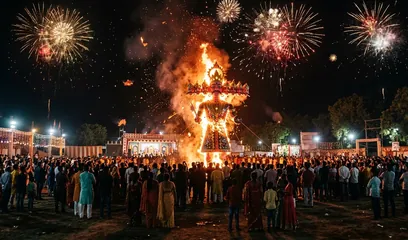
its meaningDussehra, or Vijayadashami, is Ashwin Shukla Dashami, the day after the nine nights of Navratri. It remembers two victories. Rama’s victory over Ravana is told in the Valmiki Ramayana, and tradition keeps this Dashami as its day. The Devi’s victory over Mahishasura is told in the Devi Mahatmya, and the day closes her nine nights. In the north, the Ramlila ends this evening with Ravana dahan, the burning of Ravana’s effigy.
The day is decided by the afternoon (aparahna): Vijayadashami is kept on the day Dashami holds then. It is counted among the sade teen muhurat, the three and a half days of the year when, by tradition, new work can begin without looking for a muhurat. Families do the Aparajita puja and the Shami puja in the afternoon, worship their tools and weapons, and meet elders to take their blessings.
Puja vidhi
step by step- 1Aparajita puja
In the afternoon, worship Devi Aparajita, the unconquered, with roli, akshat and flowers, as the day’s puja for victory.
- 2Shami puja
Worship the shami tree with water, roli and a diya. Tradition remembers that the Pandavas kept their weapons hidden in a shami tree during their year in disguise.
- 3Shastra puja
Clean and worship the weapons, tools, books or account books of the house, marking them with roli and offering flowers.
- 4Close the Navratri
Move the Navratri kalash, and immerse or share the sprouted barley (jawara) as your family’s custom is.
- 5Ravana dahan
After sunset, watch the burning of the effigies of Ravana, Kumbhakarna and Meghnad at the close of the Ramlila.
- 6Meeting elders
Visit elders and relatives, touch their feet and share sweets; in many places shami or apta leaves are given as a token of gold.
Puja samagri
keep it ready the day before- Roli, akshat and kalava
- Flowers and a garland
- Diya and ghee
- Water in a lota for the shami tree
- Shami leaves
- Sweets for prasad and for elders
- Tools, books or account books to be worshipped
- Haldi and kumkum
The katha of Dussehra
Source: Valmiki Ramayana, Yuddha Kanda; its link to Ashwin Shukla Dashami is tradition
Ravana, king of Lanka, carried Sita away from the Panchavati forest. Rama and Lakshmana, with Hanuman, Sugriva and the vanara army, built a bridge across the sea to Lanka, and Vibhishana, Ravana’s brother, left him to join Rama.
In the long war that followed, Kumbhakarna fell to Rama and Indrajit (Meghnad) to Lakshmana. At last Ravana himself came out to fight. Before the final battle the sage Agastya taught Rama the Aditya Hridayam, the hymn to Surya, and Indra sent his own chariot with his charioteer Matali.
Rama and Ravana fought for a long time, and Ravana’s heads grew back each time they were cut. Then Rama took up an arrow charged with the power of Brahma and struck Ravana in the chest, and Ravana fell.
Rama had Vibhishana crowned king of Lanka, and Sita was freed. Tradition keeps this Dashami as the day of that victory, and Ramlila across the north ends with it.
What to do, and what to avoid
What to do
- Do the Aparajita and Shami puja in the afternoon, since that is the part of the day that decides Vijayadashami.
- If you have been waiting to begin something new, many families choose this day for it, as one of the sade teen muhurat.
- Visit elders and touch their feet; the day is kept for blessings and for mending ties.
- Keep children at a safe distance at Ravana dahan, since the effigies are filled with fireworks.
What to avoid
- Avoid breaking branches of the shami tree; pluck a few leaves gently, since the tree itself is worshipped.
- Old quarrels are traditionally set aside on this day; it is a day for embracing and greeting, not for harsh words.
Regional names, and why dates differ
In Mysuru, the Dasara closes on Vijayadashami with a procession in which an elephant carries the image of Chamundeshwari in a golden howdah. In Kullu, Dussehra begins on Vijayadashami and runs for a week, with the deities of the valley brought in procession to Raghunath ji. In Bengal the day is Bijoya Dashami: the Durga images are immersed (visarjan), married women play sindoor khela, and families exchange Bijoya greetings. In Maharashtra apta leaves are exchanged as sona (gold), and in Kerala small children begin learning their letters.
Amanta and Purnimanta calendars both call this Ashwin, since it is Shukla paksha. Where the date moves, it is because Dashami must hold in the afternoon at each place: if it begins late one day and ends early the next, calendars apply the rule to their own city’s afternoon, so the day can differ between places by a day.
Common questions
5 questionsWhen is Dussehra in 2027?
Dussehra 2027 is on Saturday, 9 October 2027, in New Delhi. Pick your city at the top for your own date and times.
What time does Dashami begin and end for Dussehra 2027?
In IST, Dashami begins on 9 Oct, 9:02 AM and ends on 10 Oct, 11:41 AM. Dussehra is kept in the afternoon (aparahna), which is why it falls on 9 October.
When is Dussehra in 2026?
Tuesday, 20 October 2026, in New Delhi.
When is Dussehra in 2028?
Wednesday, 27 September 2028, in New Delhi.
Why is Dussehra on a different day in the US or UK?
Dussehra is kept on the day its tithi, Dashami, is running in the afternoon (aparahna). The tithi begins and ends at the same instant all over the world, but the afternoon comes at its own hour in every place, so in the US or UK the day that holds it can be a day earlier than in India. Pick your city in the box at the top and every date and time on this page is worked out for it.
A festival is the same day for everybody. Your chart is not.
Make your free kundli, or ask any of 24 astrologers what this year holds for you. You pay by the minute.






Chat with an AI astrologer
24 AI astrologers trained in Vedic Jyotish. Chat in any Indian language; call in Hindi and English.Astro VyasaVedic JyotishAstro PremLove & RelationshipAstro KuberWealth & FinanceAstro VaidyaHealth & VitalityChat from Call from Billed per minute, only while your chat or call is on. End it any time.