Holi 2027
22 March 2027
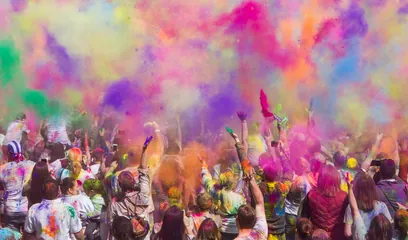
Rangwali Holi, the morning after Holika Dahan: colours, gujiya and family visits.
- Kept
- the day after Holika Dahan
- Kept
- the day after Holika Dahan
Holi in 2026, 2027, 2028
with the tithi’s timesHoli is the day after Holika Dahan.
For New Delhi, in IST.

Why Holi is kept
its meaningHoli is Phalguna Purnima, kept over two days: the evening before as Holika Dahan, the bonfire, and the morning after as Rangwali Holi, the play of colours. The Bhagavata Purana and the Vishnu Purana tell of Prahlad, a devotee of Vishnu, whose father Hiranyakashipu could not turn him from his faith. His aunt Holika, who had a boon that fire could not touch her, carried him onto a pyre meaning to burn him; the fire left Prahlad untouched and consumed Holika instead, and the bonfire each year remembers that night.
The next morning belongs to colour, and to Krishna. In Braj, popular tradition remembers how young Krishna played with gulal and water among the gopis of Vrindavan and Barsana, and that spirit of playful colour is what Rangwali Holi carries everywhere. The festival also falls as the rabi harvest nears, so for many families it is as much a thanksgiving for the fields as a story of Prahlad or Krishna, and a day to mend quarrels and start the new season afresh.
Puja vidhi
step by step- 1Gather the wood
In the days before, gather wood, dried cow-dung cakes and leaves at the spot chosen for the bonfire, often a crossing or open ground in the mohalla.
- 2Set up Holika and Prahlad
Place a small figure of Holika, sometimes with Prahlad beside her, on top of the pyre before it is lit.
- 3Puja before lighting
Walk around the unlit pyre offering roli, akshat, raw cotton thread (moli), water, gram stalks or corn ears and a coconut, praying for the family’s protection.
- 4Light and take seven rounds
Light the pyre once Purnima is truly running, and walk around it seven times, as families in the mohalla gather together.
- 5Take the bhasma home
The next morning, take a little of the cooled ash (bhasma) home and apply a mark of it, which many families hold as protection for the year.
- 6Touch feet, then play
Before the colours start, touch the feet of parents and elders, and only then begin playing with gulal and water with family and friends.
- 7Bathe, rest and visit
Bathe once the colours are done, rest, and in the afternoon or evening visit family and neighbours with gujiya and other sweets.
Puja samagri
keep it ready the day before- Wood, dried cow-dung cakes (gulari) and leaves for the bonfire
- Small figures of Holika and Prahlad
- Roli, akshat and raw cotton thread (moli)
- Gram stalks or corn ears, and a coconut
- Natural or herbal gulal and colours
- Gujiya, mathri and other sweets for visiting
- Old clothes to play in
The katha of Holi
Source: Prahlad and Holika: Bhagavata Purana and Vishnu Purana. Krishna and the colours of Braj: popular tradition of Vrindavan and Barsana
Hiranyakashipu, who had won a boon of near invincibility, wanted the whole world to worship him alone, but his son Prahlad kept his devotion to Vishnu through every punishment his father tried. His sister Holika had a shawl, or in some tellings a boon, that fire could not burn.
Holika took Prahlad onto her lap on a blazing pyre, certain she would walk out unharmed with the boy dead. The fire instead burned away the very thing that protected her, and Prahlad, protected by his faith, stepped out of the flames untouched. The bonfire each Phalguna Purnima remembers that night, good over evil.
Alongside this, Braj keeps its own memory: that Krishna, as a child in Gokul and Vrindavan, played holi with coloured water and gulal among Radha and the gopis, delighting in the colour as much as in their company. That playful spirit, rather than any single verse, is what the morning of Rangwali Holi is said to carry forward.
What to do, and what to avoid
What to do
- Use natural or herbal colours where you can, since they wash off kindly and are gentler on skin and eyes than the synthetic kind.
- Touch the feet of parents and elders before the colours start, since the day is kept for family as much as for play.
- Use the day to forgive and make up with someone you have had words with, in the old spirit of bura na mano, Holi hai.
What to avoid
- Avoid putting colour on anyone who does not want to play, or near their eyes and mouth even if they do, since the day’s joy should not come at someone else’s discomfort.
- Those with skin or breathing conditions are usually better off with dry, mild colours rather than strong ones, and a doctor’s advice is worth asking if in doubt.
- Avoid lighting the bonfire with anything other than wood, dung cakes and leaves; plastic or tyres are kept away from Holika Dahan in most mohallas now, for the air everyone shares.
Regional names, and why dates differ
Barsana and Nandgaon in Braj keep Lathmar Holi days before, where women playfully strike men with sticks in memory of Radha and the gopis. Shantiniketan and much of Bengal keep Basanta Utsav and Dol Jatra the same days, with Rabindra Sangeet and a swing for Krishna’s image rather than a bonfire-first custom. Punjab’s Sikh community follows Holi with Hola Mohalla, a day of mock battles and martial displays begun by Guru Gobind Singh ji.
Maharashtra and parts of the south keep an extra day, Rangpanchami, five days after Purnima, as the last and sometimes the most colourful day of play. Mathura and Vrindavan stretch the festival across more than a week of temple events leading up to Rangwali Holi.
Common questions
4 questionsWhen is Holi in 2027?
Holi 2027 is on Monday, 22 March 2027, in New Delhi. Pick your city at the top for your own date and times.
When is Holi in 2026?
Tuesday, 3 March 2026, in New Delhi.
When is Holi in 2028?
Saturday, 11 March 2028, in New Delhi.
Why is Holi on a different day in the US or UK?
Holi is the day after Holika Dahan, so it moves with it. Holika Dahan is kept on the day its tithi, Purnima, is running in pradosh kaal, the evening after sunset. The tithi begins and ends at the same instant all over the world, but sunset comes at its own hour in every place, so in the US or UK the day that holds it can be a day earlier than in India. Pick your city in the box at the top and every date and time on this page is worked out for it.
A festival is the same day for everybody. Your chart is not.
Make your free kundli, or ask any of 24 astrologers what this year holds for you. You pay by the minute.





Chat with an AI astrologer
24 AI astrologers trained in Vedic Jyotish. Chat in any Indian language; call in Hindi and English.Astro VyasaVedic JyotishAstro PremLove & RelationshipAstro KuberWealth & FinanceAstro VaidyaHealth & VitalityChat from Call from Billed per minute, only while your chat or call is on. End it any time.